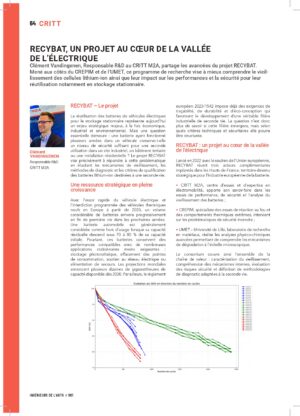



Second-life lithium-ion batteries: a key challenge for the energy transition
Second-life lithium-ion batteries play a vital role in the energy transition. Reusing electric vehicle batteries in stationary energy storage systems extends their service life and reduces their environmental impact. Before they can be repurposed, however, their performance, reliability, and safety must be carefully assessed.
The RECYBAT project supports second-life lithium-ion batteries
CRITT M2A is participating in the RECYBAT project alongside CREPIM – Material & Fire Test Expert and UMET. Together, the partners are studying the ageing mechanisms of lithium-ion cells. Their goal is to develop more reliable diagnostic methods and establish robust qualification criteria for batteries intended for second-life applications.
The teams are investigating how operating conditions affect cell performance. They are also identifying the most relevant parameters for accurately assessing a battery’s condition before it is reused.
More reliable qualification criteria for second-life lithium-ion batteries
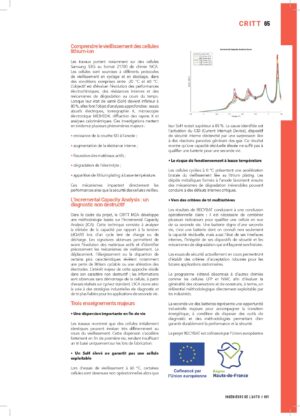
The first results show that temperature and thermal management strategies have a significant impact on battery ageing. They also demonstrate that evaluating the State of Health (SoH) based solely on remaining capacity is not sufficient to determine whether a battery can be safely reused.
Researchers are therefore adopting a more comprehensive approach by combining several indicators to assess battery performance, overall health, and safety. This methodology improves battery qualification and strengthens confidence in second-life solutions.
CRITT M2A supports innovation in battery technologies
Through the RECYBAT project, CRITT M2A contributes to the development of innovative solutions for second-life lithium-ion batteries. This research supports industrial partners in their R&D projects while promoting more sustainable mobility and better battery reuse.
The RECYBAT project is co-funded by the European Union.