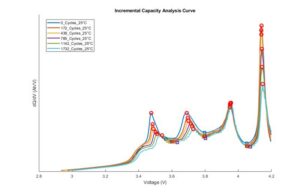



Incremental capacity analysis for batteries is now a key method for understanding the aging of lithium-ion batteries. It enables the evaluation of the state of health (SOH) without opening the cell, thereby addressing a major challenge in terms of performance and durability.
Unlike conventional methods, this approach relies on analyzing the dQ/dV signal measured during constant current charge or discharge cycles. This signal reveals characteristic signatures, in the form of peaks and variations, which directly reflect the physicochemical phenomena occurring within the cell.
Thanks to incremental capacity analysis for batteries, teams can monitor cell evolution over time and more easily identify performance losses. As a result, they gain a better understanding of degradation mechanisms while benefiting from a method that does not require any destructive testing.
At CRITT M2A, this approach is implemented as part of the RECYBAT project, with work focusing on several key aging parameters. For instance, teams analyze curves at different cycle stages to track performance evolution, while also studying the impact of temperature on degradation mechanisms. In addition, they observe battery behavior under conditions close to real use, enabling the collection of representative and directly actionable data.
The results obtained at 25°C confirm the relevance of this method. Indeed, incremental capacity analysis for batteries makes it possible to anticipate aging and contributes to improving system durability.
This project, co-funded by the European Union, demonstrates this commitment. In this context, CRITT M2A continues to strengthen its efforts in innovation, with a clear objective: to support the development of lithium-ion batteries and accelerate the electrification of applications.